• Defeating our Shadows

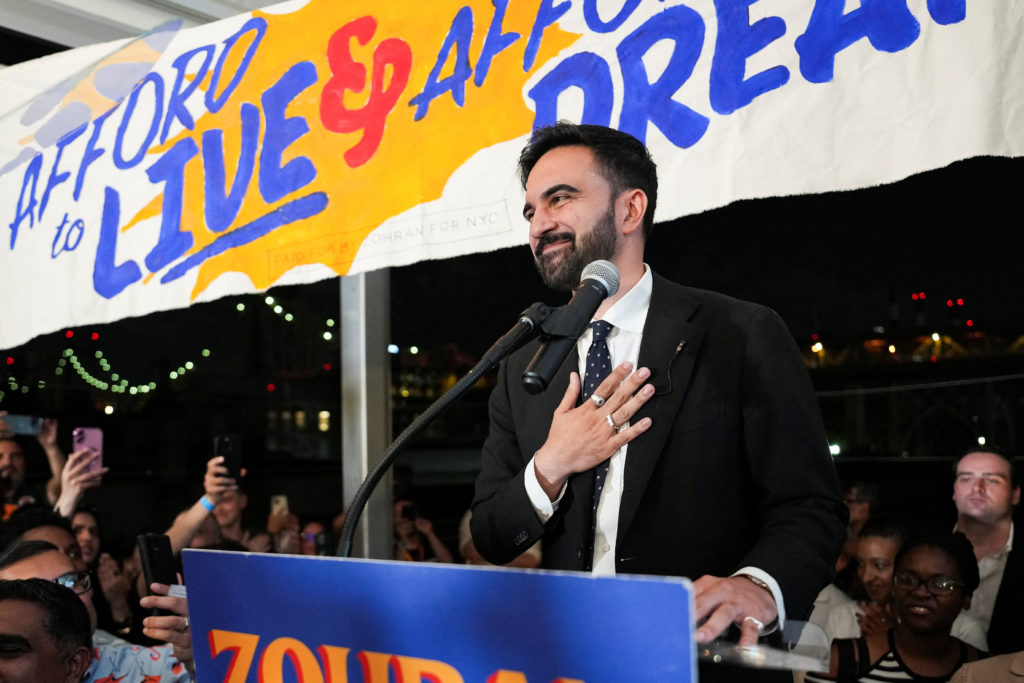
    Following the colossal victory of Mamdani, Donald Trump posted, “And so it begins!” I am not sure when the last time I agreed with Trump was. Yes, and so begins a new age of politics because young Americans will now, as they did in New York, demand the “impossible.” That is what young New Yorkers did when they rallied around an outsider, Muslim and Democratic Socialist Zohran Mamdani, and, despite the overwhelming odds, won.

    The victory signals a major crisis of hegemony because it inaugurated a new horizon of possibility. This was made possible, not because we defeated Andrew Cuomo, but because we defeated our own impotence: decades of false hope in two-party politics and our cynical reasoning.

    We need to take a step back to realize that this is bigger than about Mamdani and Cuomo. It is about an evolving and generational shift in public attitude that can potentially create tectonic shifts in our political landscape. And so, the debates about whether Mamdani is really just another careerist Democrat misses the point entirely.

    For the past two decades, political thinking and action seemed impossible in the face of the colossal powers of the corporate state. We were barred from politics, not through state violence, but through cynical reason: What can we do against these odds? The game is rigged. Election after election, the Democratic Party proved to be as complicit in empowering the corporate state, and as a result disempowering us, as the GOP. Yet, many still saw the Democrats as a lesser of two evils. What other options did we have?

    The late Mark Fisher called this condition reflexive impotence. It occurs when we know that the system is bad but simultaneously believe that we cannot do anything about it. In turn, this lack of action prolongs the longevity of the state and perpetuates a sense of despair and self-imposed impotence. And yet, even outside of politics, the pursuit of “self-optimization” and “climbing up the ladder” was also rigged: there was no escape; the forces that crippled politics pervaded everything. Against such odds, what can we do?

    But history proves that decades of inertia and repression do not necessarily breed docility, but quite the opposite. Indignation doesn’t come, en masse, from coming to believe in the tenets of an ideology, although that is possible. Few of those who voted for Mamdani, I would assume, read any leftist literature. Revolutions are driven by a desire that does not signify a lack, as the common understandings of desire assume, but a productive and creative imagining of a new world.

    I began this by saying that a new horizon has been inaugurated, but whether or not this will amount to a new politics entirely remains to be seen. The biggest threat to this project is not Trump cutting federal funds to New York, or even sending in ICE and the National Guard. The real threat is ourselves, lapsing back into an attitude of cynical reasoning.

    What forms can those threats take? Mamdani’s greatest blunder will be if he does not lead his movement and the Democratic Socialists of America to a political terrain independent of the Democratic Party. Anything less will be political suicide and prove to be a setback of historic proportions for the Left.

    And so, how do we avoid such a setback? How do we submit? asks Wendell Berry in his ruminations on why Americans are so submissive to the corporate state. He gives an answer to his own question: By not being radical enough.

  • This paper delves into the existential core of Ali Shariati’s thought, exploring his concept of the revolutionary intellectual as fundamentally rooted in an ontological understanding of man. Shariati, drawing from both Islamic tradition and existentialist philosophy, posits man as a being defined by a perpetual struggle between earthly immersion and transcendent aspiration. Emphasizing man’s inherent freedom, choice, and capacity for self-awareness, the paper argues that Shariati’s work is a profound meditation on the human condition, confronting the anxieties of existence and the imperative for authentic being. By examining Shariati’s critique of determinism and his call for a “return to the self,” this analysis highlights the existential dimensions of his revolutionary ideology, wherein worship, action, and protest become existential acts of self-affirmation and engagement with a meaningful cosmos. Ultimately, this paper illuminates how Shariati’s thought confronts the existential crisis of alienation, offering a path towards a life of purpose and responsibility through a reclamation of man’s ontological vocation.

    Link

  • Is it possible to critique secularism in a thoroughly secular age? Is it possible to invoke the divine while dwelling within the “immanent frame”—i.e., the modern view that everything in our world can be understood without reference to any external, transcendent order? I want to suggest, in this essay, that we can critique secularism in a secular age, but only by identifying the metaphysical boundaries of the secular age—those boundaries that demarcate the real from the unreal, and the legitimate from the illegitimate.

    Read More

  • You cannot understand tawḥīd, the principle, governing the cosmos, without understanding its negations: tughyān (lit. transgression). If tawḥīd is a form of critical consciousness then awareness of who or what is the tāghūt is pivotal to that awareness. Sherman A. Jackson captures the meaning of the term tāghūt brilliantly as “second-creators.” The second creators do not create man ex nihilo (that can only be done by the First-Creator) but create new political, economic and social [ersatz, lower-order] realities. But beneath those forged realities is a forged metaphysical order, or image because every political order and image is a reflection of a more fundamental metaphysical order and image. The second-creators become God-like because these forged realities appear to be natural, eternal, and insurmountable. To live in a world defined by the second-creators is to live in existential absurdity because the world becomes governed by an abyss, or baṭil. How to rebel against these reified “realities?” Metaphysical disobedience.

  • فَفِرُّوٓا۟ إِلَى ٱللَّهِ

    “…Flee, therefore, to Allah…”

    Tawhīd entails the affirmation of the absolute oneness and uniqueness of God, the absolute, necessary creator whose act of perpetual creation generates and sustains all that is in the world, all of which is contingent and subordinate to His command. In this most basic theistic paradigm is a powerful liberatory force against all oppressive worldly orders. This is because the hallmark of any oppressive order is the arrogation of superiority and ultimate sovereignty to itself, an arrogation that is vehemently denied by twin testimonies of tawhīd. This short reflection will articulate this argument, leaning on the work of Enrique Dussel and Taha ʿAbd al-Rahman, through a theorization of the created world as the meta-order that grounds modern oppressive orders, and a distinction between the world-as-dunyā and the world-as-ʿālam.

    Read More

  • The dunyā is a pantheon of idolatry, much like the Kaaba before the advent of Islam. To recall, In a previous meditation, I distinguished between the world-as-dunyā (lit. that which is close, lowly, the closed world) and the world-as-‘alam (lit. a sign, the open world). I am not referring to two different worlds but one world that can be perceived in two ways, amounting to two existential orientations. The dunyā is immanent and closed; in turn, it turns contingent differences between creatures (e.g., race, class, etc.) into reified hierarchies. In contrast, the world-as-‘alam recognizes only one real and absolute hierarchy: the ontological differentiation between the Creator and the created because God is uniquely transcendent and created the world ex nihilo.

  • Fasting is a revolt against the modern condition. It is an existential act of disobedience against the secular age. It is existential in that it situates man at the crossroads between two existential orientations (how to be in the world) and by orientation I mean a consciousness, attitude, and the totality of our behavior. Moreover, to understand fasting as an existential act, it is imperative that we say something about the nature of man. Ali Shariati reminds us that man is constituted by two poles: tin (clayness), which is sedentary and driven towards the corporeal, and the rūḥ (spirit), which is driven towards the sublime and transcendence. It is an act of disobedience in that the secular age reduces man to a one-dimensional man (to borrow a term from Herbert Marcuse), or what Taha ‘Abd ar-Rahman calls the horizontal man whereas the act of fasting cultivates the vertical self that drives towards the sublime.

  • The long-standing and late Tunisian President Habib Bourguiba, who reigned over Tunisia for almost three decades, represents but one of the encroachments of the modern liberal order in the Muslim world. In the year 1960, as part of an ongoing secularisation effort, Habib Bourguiba declared that fasting in Ramaḍān hampered economic productivity and asked Muhammad b. ʿĀshūr, an esteemed scholar of the time, to issue a fatwa to justify the abandonment of the practice. Ibn ʿĀshūr went on public radio and responded:

    “Prescribed for you is fasting” and announced, “God has spoken the truth and Bourguiba has spoken falsehood”.[1]

    This incident between Ibn ʿĀshūr and the secular elitist Habib Bourguiba came to represent a lofty illustration of the challenges that fasting – as a praxis – poses to the modern condition. In reminiscing over this incident, I was spurred to ask: how are we to make sense of this practice in an age of liberal hegemony – an act which is seemingly anomalous to the logic of economic productivity and progress?

    Read More

  • There are two obstacles to liberation: aid and reform. However, well-intentioned aid perpetuates the dependence of the oppressed. Similarly, reform is the illusion that the oppressed can depend on the ruling elite to ‘grant’ them certain rights. In both instances, the oppressed relinquish decision: the decision to liberate oneself. In both instances, the ‘Other’ absorbs the self into his own project, into the narrow horizons of its own decisions. In both instances, the self anticipates the future without a desire “to penetrate it and discern its relevance for his presence decisions.” In both instances, the self is alienated from its existential uniqueness (the capacity to decide and choose) and loses its alterity (autonomy).